
Hernando County Criminal History Checks
First decide which fact must be proved. The HCSO Inmate Search is the quickest official source for a recent booking, including people booked by agencies other than the Sheriff. The separate HCSO arrest search covers only arrests made by HCSO. Filed CF felony, MM misdemeanor, and CT criminal-traffic cases appear through the Clerk. FDLE supplies the broader Florida repository search. These sources answer different questions, so a sound check may use more than one.
Use a full legal name, spelling variants, and date of birth when an official form permits them. A common name alone is weak proof of identity. Case and booking numbers are much stronger. The practical sequence is:
- Search the jail for a recent booking and note the booking number.
- Check the arresting agency for the report or arrest affidavit.
- Search the Clerk by case number, name, and the correct CF, MM, or CT category.
- Read each count, disposition, and sentence rather than relying on case status alone.
- Use FDLE or fingerprint-based personal review when statewide, identity-linked history is needed.
Four Hernando Record Systems Compared
A single event can leave four records. HCSO records the arrest and central jail intake. The Hernando Clerk records what prosecutors filed and how the court ruled. FDLE compiles reportable Florida history. FDC records state prison custody and adult felony supervision. A name absent from one system may still appear in another because their scope, timing, and purpose differ.
| System | Best use | Key limit |
|---|---|---|
| HCSO | Arrests, reports, bookings, warrants | Not the final court outcome |
| Clerk | Filed cases, dockets, dispositions | Hernando cases only |
| FDLE | Florida criminal-history search | Name search is not fingerprint identification |
| FDC | State custody and supervision | Does not cover county jail custody |
The Hernando County Sheriff’s Office homepage shows the local agency’s online entry points.
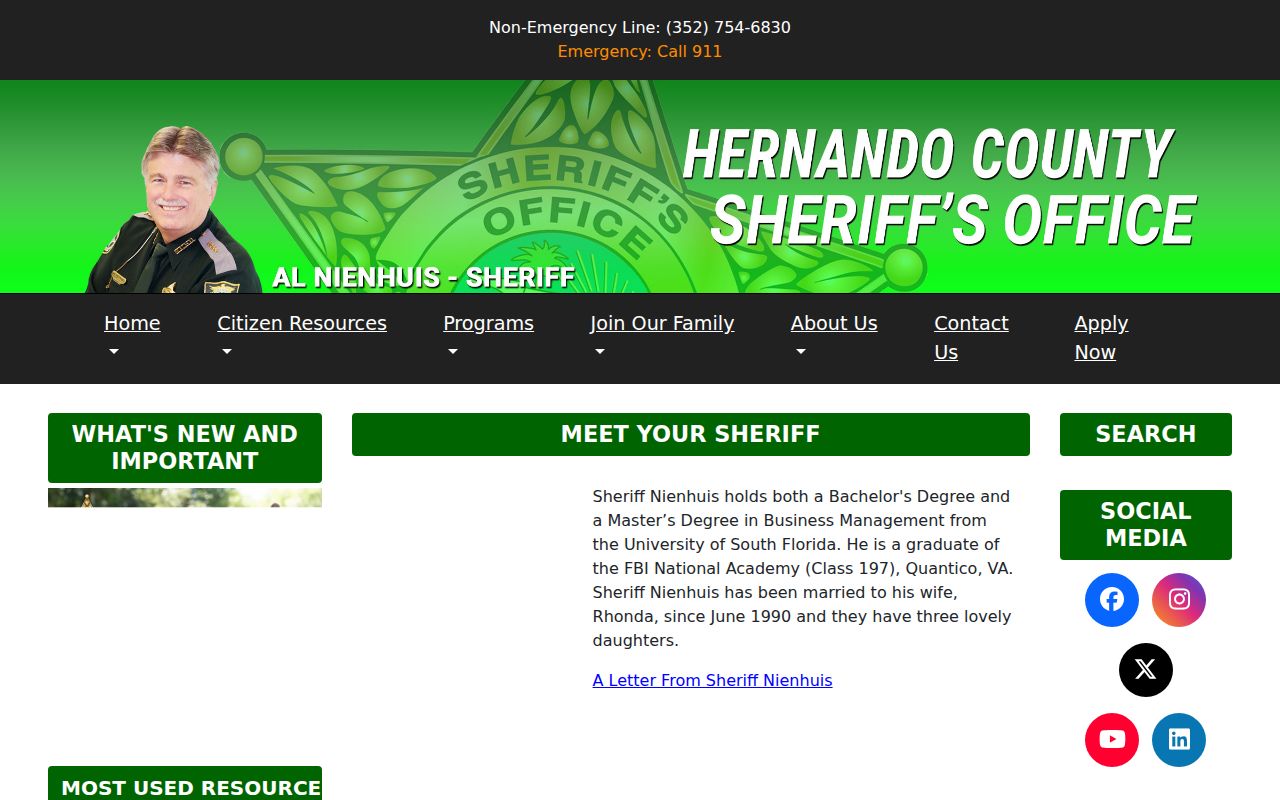
That agency hub leads to public records, jail, arrest, and warrant tools, while court outcomes remain with the Clerk.
Official Background Checks in Florida
The Florida Department of Law Enforcement, Division of Criminal Justice Information Services, is Florida’s central criminal-history repository. Its Instant Florida Criminal History Search lets any member of the public submit demographic data. The noncertified result costs $24 plus a $1 card-processing fee and can be printed or emailed. An FDLE staff-processed certified or noncertified search costs $24. FDLE states five business days for noncertified work and six to seven business days for certified work, excluding mail time.
For review of one’s own identity-linked record, use FDLE’s personal-review and challenge process. Fingerprints reduce the risk of a common-name mismatch. Florida uses approved Livescan providers for checks authorized by statute, and the requesting agency must give the applicant its ORI. FDLE cannot supply that code. The FBI Identity History Summary is a separate subject-only national process.
| Product | Method | Fee or access |
|---|---|---|
| FDLE Instant | Demographic name search | $24 plus $1 card fee |
| FDLE staff search | Certified or noncertified | $24 |
| FDLE ORI search | Authorized agency route | Varies by authority |
| Clerk copies | Known Hernando case | $1 per page, certification extra |
The FDLE Florida checks page distinguishes instant, staff-processed, and ORI routes.
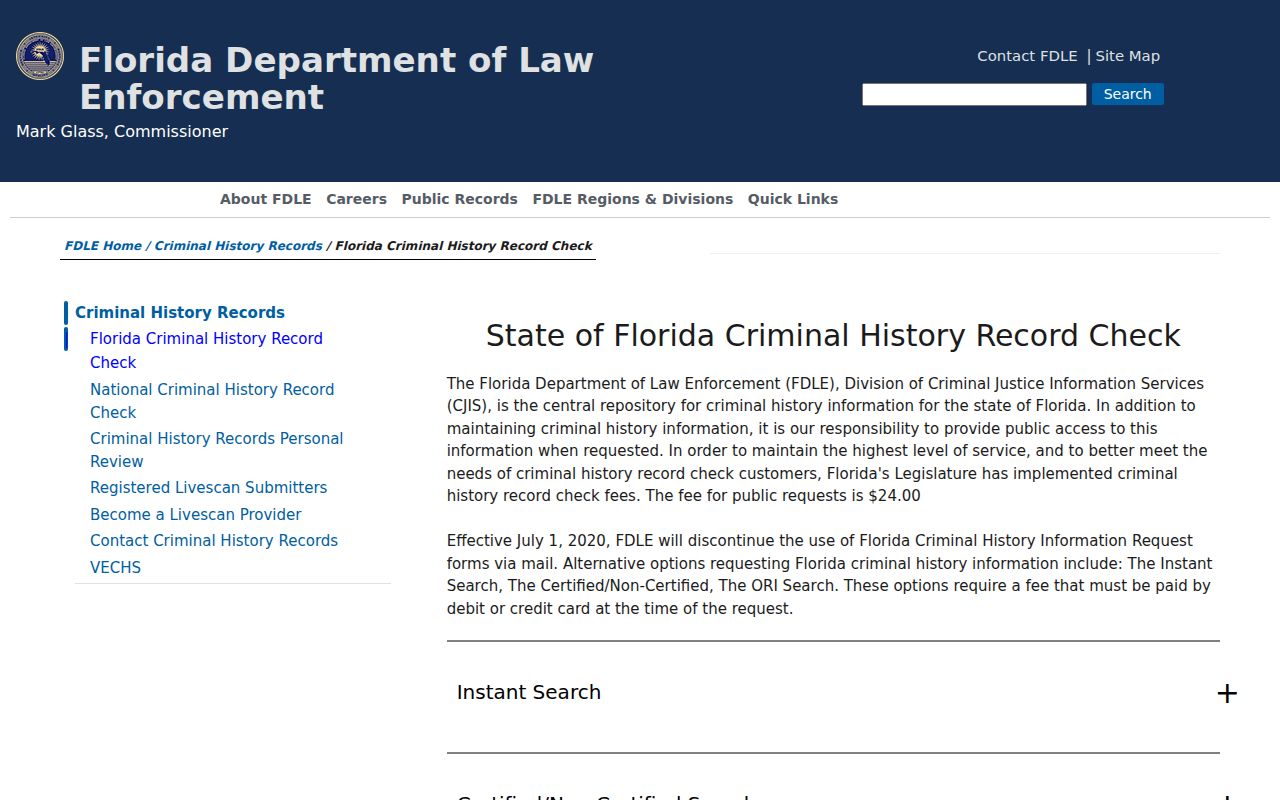
Those choices matter because speed, certification, identity method, and authorized use are not the same across products.
Hernando Sheriff Record Requests
HCSO’s Public Records Unit handles Sheriff-maintained incident and offense reports, arrest material, calls for service, booking information, and body-worn-camera records, subject to exemptions and redaction. Requests may be made through the web portal, by telephone, or in person. The unit accepts phone and counter requests weekdays from 9:00 a.m. to 5:00 p.m. at 18900 Cortez Boulevard in Brooksville. Its direct number is 352-797-3635.
A useful request gives the date and time range, street or cross streets, event or case number, desired record type, and delivery format. Florida law generally does not require a stated purpose. HCSO permits the portal name “Anonymous,” yet a valid email is still needed to manage an online request. Extensive research or copying may lead to a special service charge based on the lowest-paid qualified worker after the first half hour.
The HCSO Public Records page explains its request channels and scope.
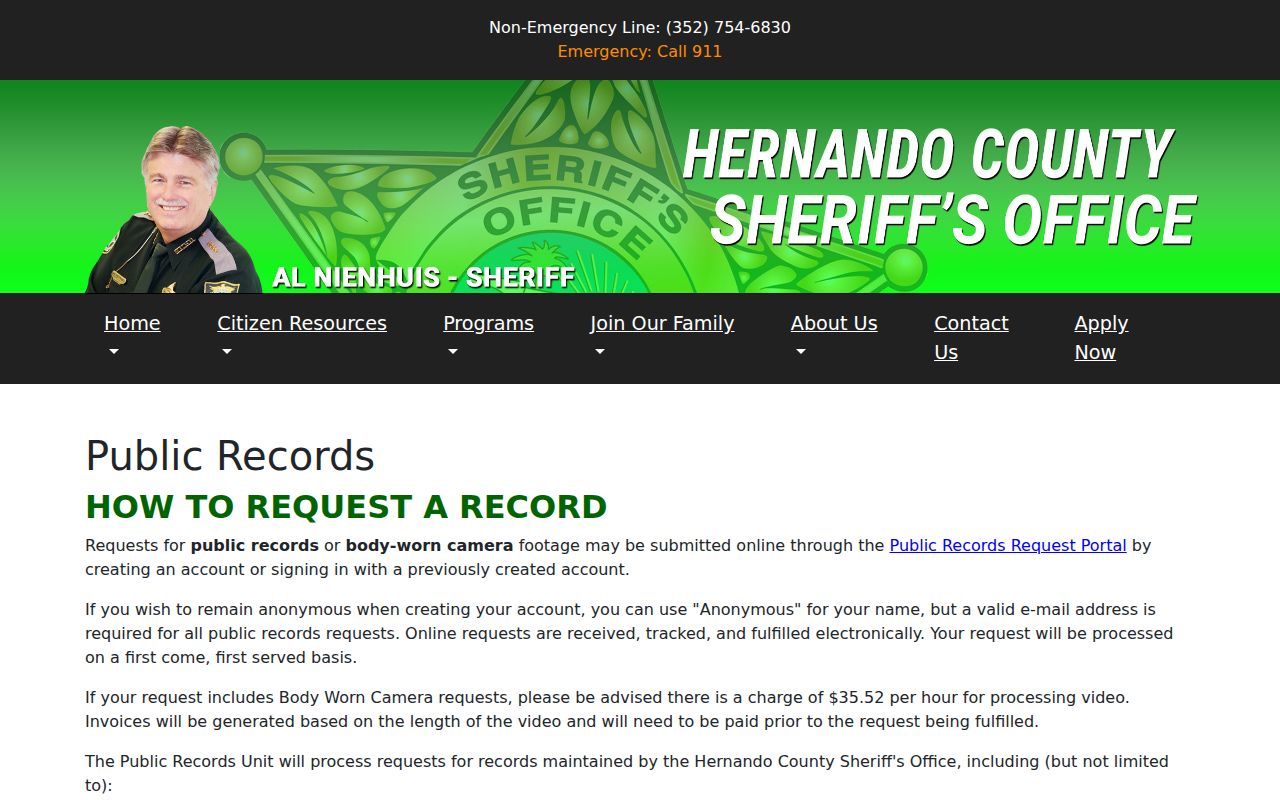
This formal route fills gaps when a free web search lacks the report, video, or detail a reader needs.
Kinds of Criminal Records
Hernando County criminal records are created at different points. An officer writes an incident report and arrest affidavit. Detention staff make a booking record. The State Attorney decides whether and what to file. The Clerk then preserves the court docket, documents, judgment, and sentence. FDLE receives reportable data, and FDC tracks state custody or supervision.
- Arrest and booking: alleged offenses, intake identifiers, bond, custody, and release data.
- Court case: filed charges, hearings, pleas, motions, disposition, and sentence.
- Warrant: court-issued process tracked for service by law enforcement.
- State history: FDLE’s compilation of reportable arrest cycles and matched outcomes.
- Custody and supervision: county jail, FDC prison, probation, or older parole-related status.
- Registry: statutory sexual-offender or predator information, not a full history or risk score.
Juvenile, protected victim, active-investigation, sealed, and expunged information may be withheld. A redaction does not mean an entire incident is secret.
Hernando Warrant Search Blind Spot
HCSO’s local warrant report searches by date, first and last name, street, city, and state. Results may show the case number, warrant number, type, and listed address. The key local warning is a three-day posting delay. A new warrant may not appear yet, and a sealed warrant will not be public. HCSO also says it will not give warrant information by phone.
The official HCSO Local Warrants report displays both the fields and its currency warning.
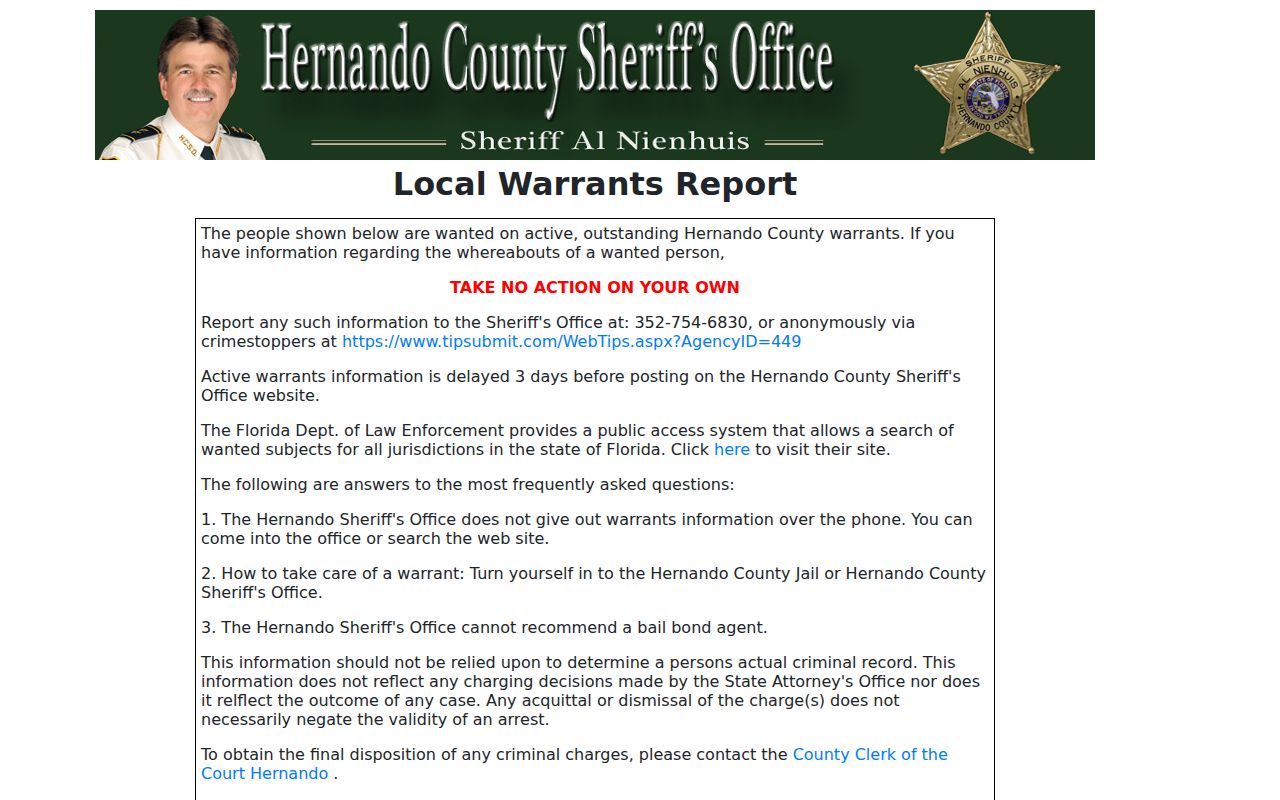
Use the related Clerk case to check issuance, later service or recall, and disposition. FDLE Wanted Persons adds a statewide layer. Anyone who locates another person should report the information and take no independent action. A person addressing their own warrant should seek case-specific legal advice before selecting a resolution route.
Hernando County Criminal Records: What They Contain
The fields depend on the custodian. A booking profile centers on intake and custody. A Clerk summary centers on prosecution. An FDLE history links identity, arrest cycles, and reported outcomes. Read each product on its own terms instead of merging them into one supposed record.
| Name and identifiers | Legal name, aliases, date of birth, sex, race, and agency identifiers where lawfully released. |
|---|---|
| Arrest and booking | Agency, date, booking number, alleged offenses, bond, custody, and release status. |
| Charges and statutes | Initial allegations may differ from the information later filed by the State Attorney. |
| Disposition | Plea, verdict, dismissal, no information, nolle prosequi, or another count-specific result. |
| Sentence | Confinement, probation, fines, restitution, and other court orders. |
| Custody or supervision | County jail, FDC prison, probation, community control, or qualifying release status. |
A “closed” court status does not itself mean dismissed. Withheld adjudication is not an acquittal. Financial Summary amounts do not establish the disposition. These local docket distinctions make the case number and count-by-count history more useful than a result-list label.
Choosing Hernando Records Counters
The 1913 Hernando County Courthouse at 20 North Main Street in Brooksville is the main destination for felony, misdemeanor, and criminal-traffic files. The Clerk is open weekdays from 8:00 a.m. to 5:00 p.m. The Spring Hill office at 7405 Forest Oaks Boulevard is open weekdays from 8:00 a.m. to 4:30 p.m. and can take criminal or traffic payments and supply certified copies. The downtown office remains the better choice for a complex or archived file.
The jail is elsewhere, at 16425 Spring Hill Drive. It handles central intake, not final case outcomes. HCSO’s records office holds Sheriff reports, while the State Attorney controls charging but is not the public court-file custodian. The Clerk locations page sets out both public counters.
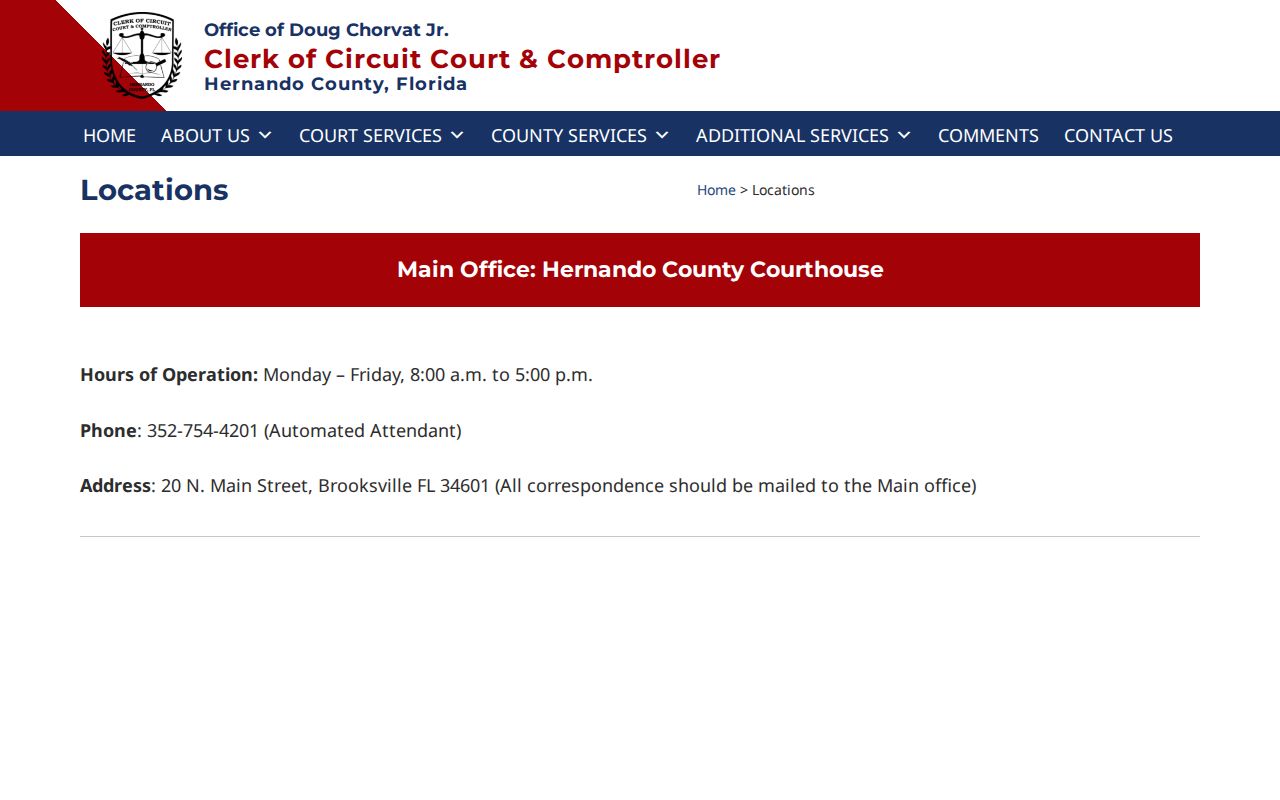
The two-counter option is especially useful because populous Spring Hill is unincorporated and has no municipal clerk or police department.
Hernando Clerk
20 N. Main St., Brooksville, FL 34601
352-754-4201
Weekdays, 8:00 a.m.-5:00 p.m.
HCSO Public Records
18900 Cortez Blvd., Brooksville, FL 34601
352-797-3635
Weekdays, 9:00 a.m.-5:00 p.m.
Detention Center
16425 Spring Hill Dr., Brooksville, FL 34604
352-544-2334
Booking and custody records
Florida Public Access Laws
Florida’s Constitution and Public Records Law favor access to nonexempt government records, but separate rules govern judicial confidentiality and criminal-history dissemination. A custodian may redact protected identifiers, victim information, juvenile material, medical details, or active-investigation content. Court images can also be restricted even when a public docket entry remains visible.
Key access rules:
Florida Constitution, article I, section 24 establishes public-record access subject to lawful exemptions.
Florida Statutes section 119.07 governs inspection, copying, fees, and custodian duties.
Florida Statutes section 943.053 governs FDLE criminal-history dissemination.
Florida Rule 2.420 identifies confidential judicial records and access procedures.
Florida Statutes section 943.0585 sets the main court-ordered expunction framework.
The Clerk accepts Chapter 119 requests by email, mail, phone, fax, or in person. A known court case is often faster through the one-case copy form. That form lists $1 per page, $2 more for certification, $7 for exemplification, actual postage, and a 3.5 percent card convenience fee.
Inside Florida’s History Search
FDLE’s instant search is a customer-run demographic check. Before paying, use exact identity details and understand that an apparent match is not fingerprint confirmation. The product may connect reportable history from contributing Florida agencies, but it is less document-rich than a Hernando Clerk case file. Reporting lag and unmatched identifiers can also cause differences.
The Instant Florida Criminal History Search is the official transaction portal.
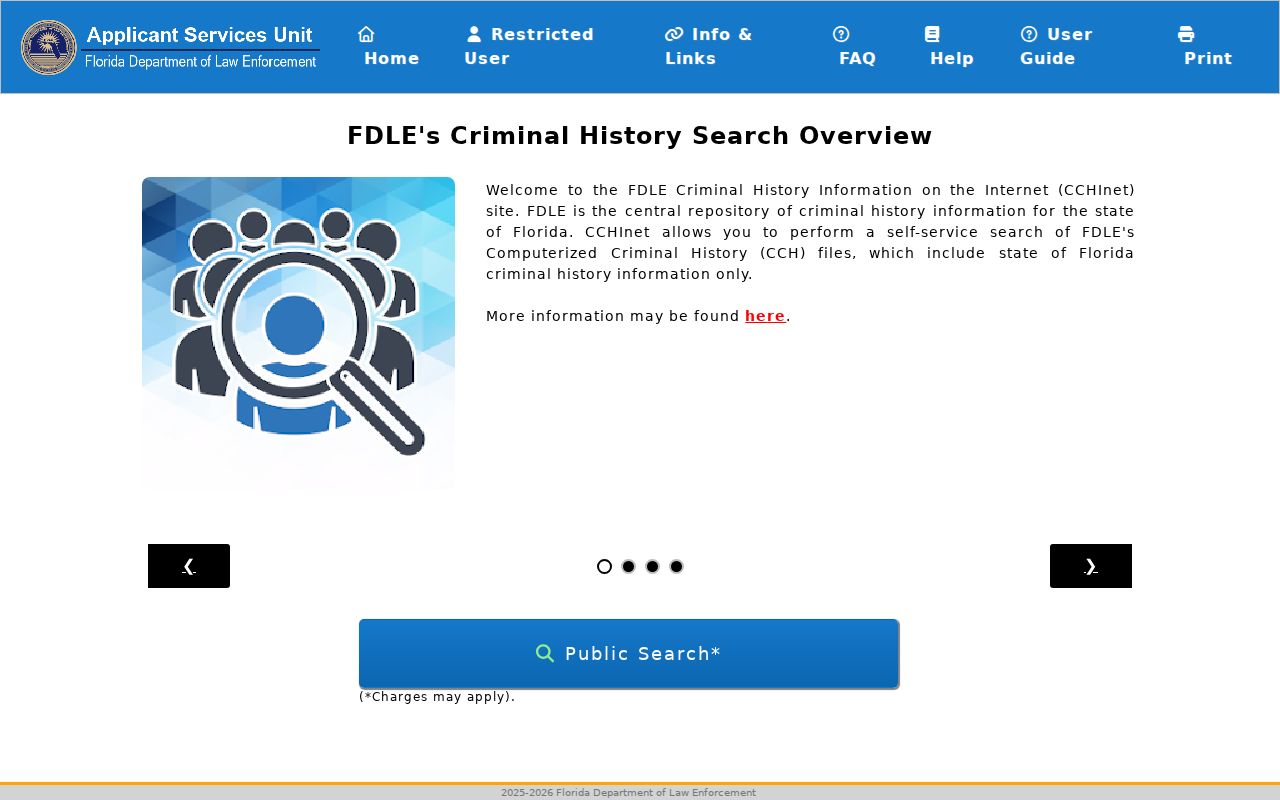
A person reviewing their own record can use FDLE’s fingerprint-based personal review, then challenge an incorrect or missing disposition with certified support from the contributing court or agency.
- Disposition
- The outcome of a charge or count, such as conviction, acquittal, or dismissal.
- Arrest cycle
- The repository grouping that ties an arrest event to submitted charges and later reported outcomes.
- Personal review
- An identity-based process for inspecting and, when supported, correcting one’s own FDLE record.
- ORI
- An agency identifier supplied for a fingerprint check authorized by a specific law or program.
Restricted, Sealed & Expunged Records
Florida separates court-ordered sealing from court-ordered expunction. Sealing hides a qualifying record from ordinary public access while preserving restricted access. Expunction generally requires specified agencies to destroy or restrict qualifying records under the statute, though limited lawful access can remain. Neither remedy should be confused with a case dismissal.
FDLE issues a Certificate of Eligibility before a person files the petition. Section 943.0585 governs court-ordered expunction, section 943.059 governs court-ordered sealing, and section 943.0595 addresses automatic sealing of qualifying nonconviction history. Eligibility turns on the full case and prior history. Juvenile and confidential records follow their own rules. If a public portal still shows a record after relief, contact that custodian and provide the court order through its correction process.
Hernando’s Central Booking Record
The Hernando County Detention Center is the single central intake point for county law-enforcement agencies. Its authorized capacity is 812. Staff create the booking number, photograph and fingerprints, attach received charges and bond data, and track custody or release. HCSO warns that this is only booking information. It does not reflect the State Attorney’s later filing choice or the court’s judgment.
That distinction matters when someone bonds out before a search. Toggle “Include Released” in the jail tool and use a booking-date range. Then check the Clerk after charging review. The Detention Center passed planned and unannounced Florida Model Jail Standards inspections in 2025 and was reaccredited that June. Those milestones address facility standards, not whether a specific booking allegation is true.
Hernando Records After County Jail
A person no longer in the county jail may have been released, transferred, or sentenced to state custody. Start by including released people in the HCSO jail search. Read the Clerk’s judgment and sentence next. If the sentence involves Florida prison or adult felony supervision, search the Florida Department of Corrections. VINELink can provide custody notifications, but it is not the official source for a court outcome.
The FDC Offender Search covers state prison and supervision records.
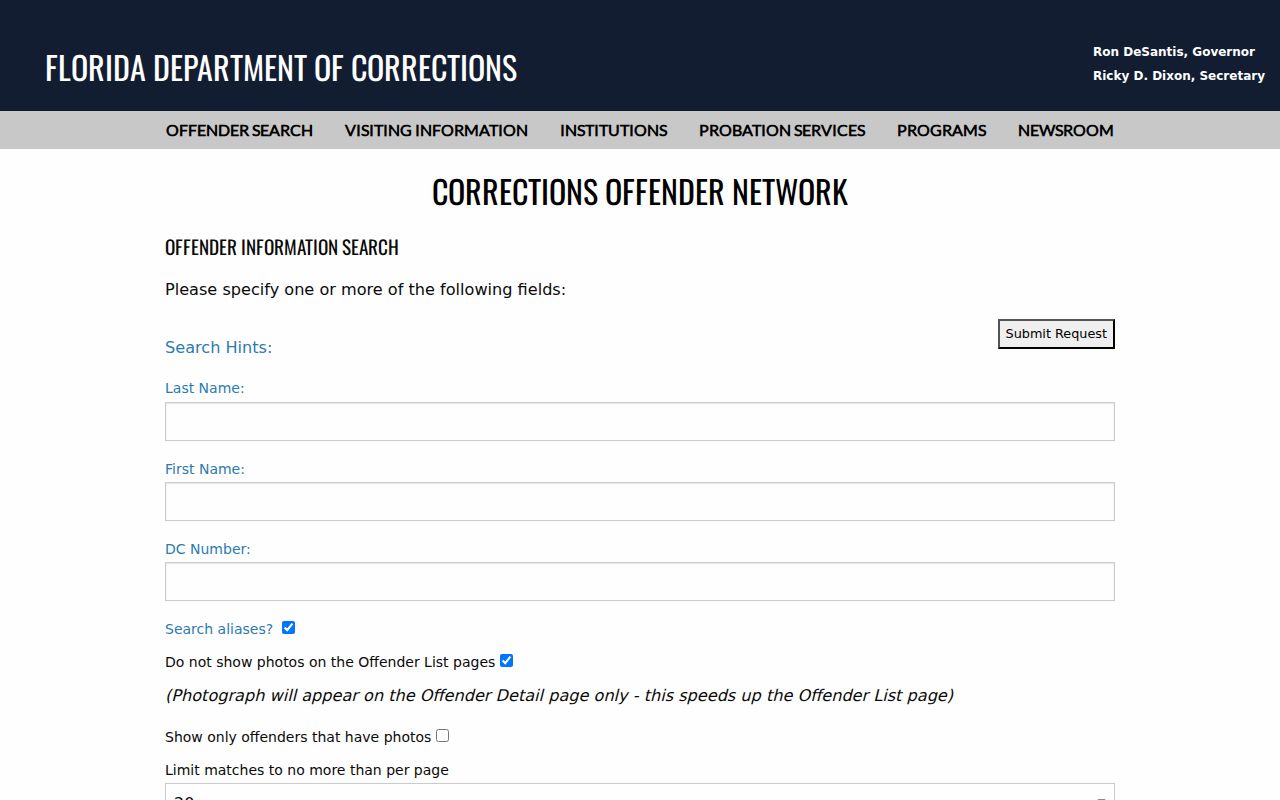
Modern Florida records may say probation, community control, or conditional release rather than parole. Traditional parole applies mainly to older eligible offenses because Florida abolished it for most offenses committed on or after October 1, 1983.
Federal Cases Beyond Hernando Records
Hernando County is within the U.S. District Court for the Middle District of Florida. Federal criminal dockets do not appear in the Hernando Clerk system. PACER supplies federal docket and document access after registration, while the Bureau of Prisons locator covers federal custody. A sealed federal warrant will not appear in ordinary public docket access.
The Middle District of Florida website is the official starting point for divisional and court information.
This federal layer is separate from FDLE’s Florida repository, the county court file, and the FBI subject-only Identity History Summary.
City-by-City Criminal Records in Hernando County
Brooksville is Hernando County’s only incorporated city. It is the county seat, but it has no current city police department or municipal criminal court. HCSO supplies city law enforcement, the county detention center processes bookings, and the Hernando Clerk keeps filed Circuit and County Court cases. The Brooksville City Clerk instead holds municipal administrative records such as ordinances, minutes, contracts, and code-enforcement material.
Brooksville Record Check
Population estimate 10,145 in 2025. HCSO handles law enforcement; county courts handle criminal cases.
Spring Hill is an unincorporated place, and the former City of Weeki Wachee was dissolved in 2020. Creating city police or municipal-court routes for either would misstate Hernando County’s government structure.